Single-piece EPDM rubber and seamless GRP fibreglass flat roofs for extensions, dormers and garages: installed to fall, detailed properly at the edges, priced as one fixed sum.
What flat roof installation & repair in Glasgow actually involves
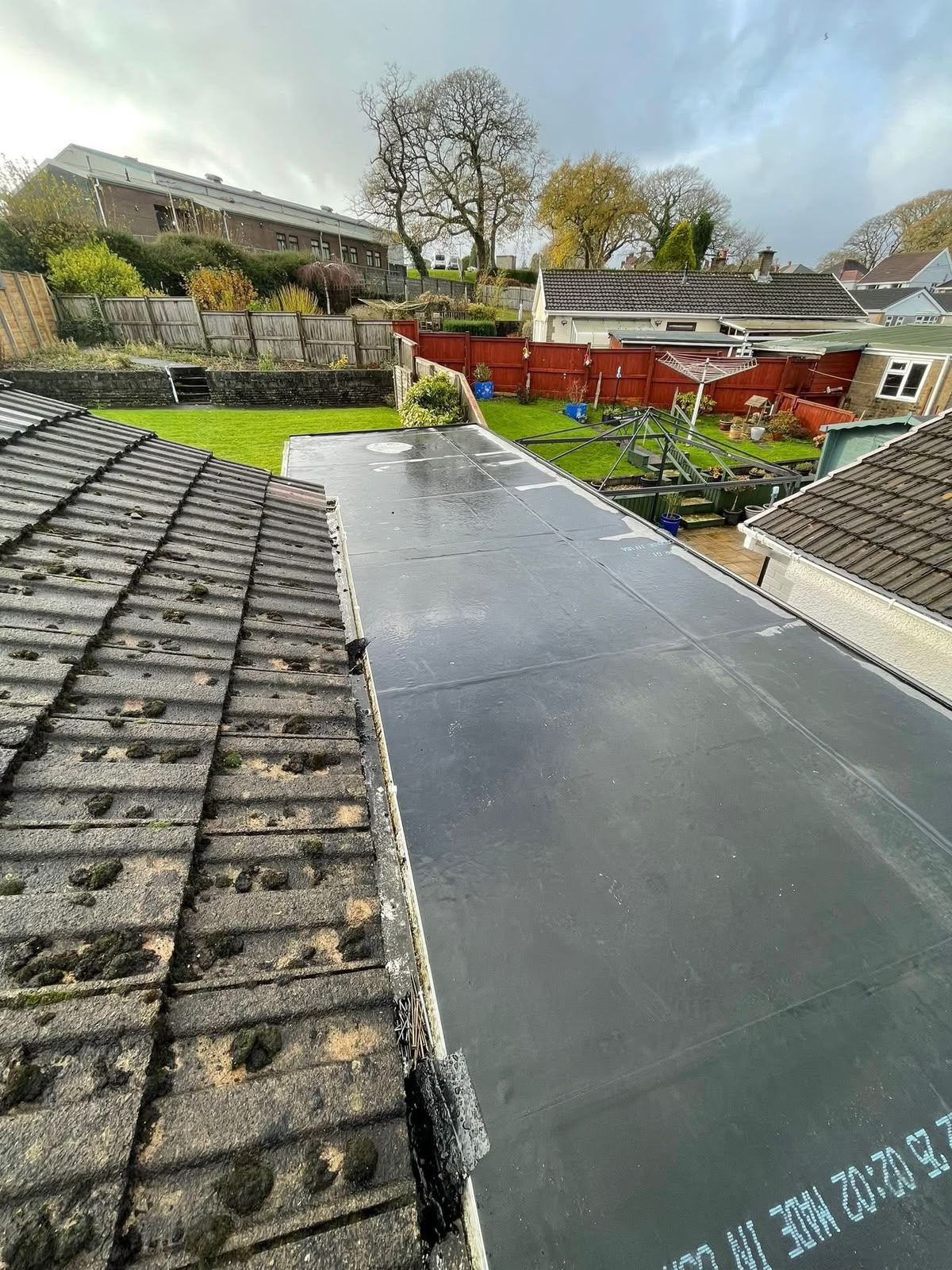
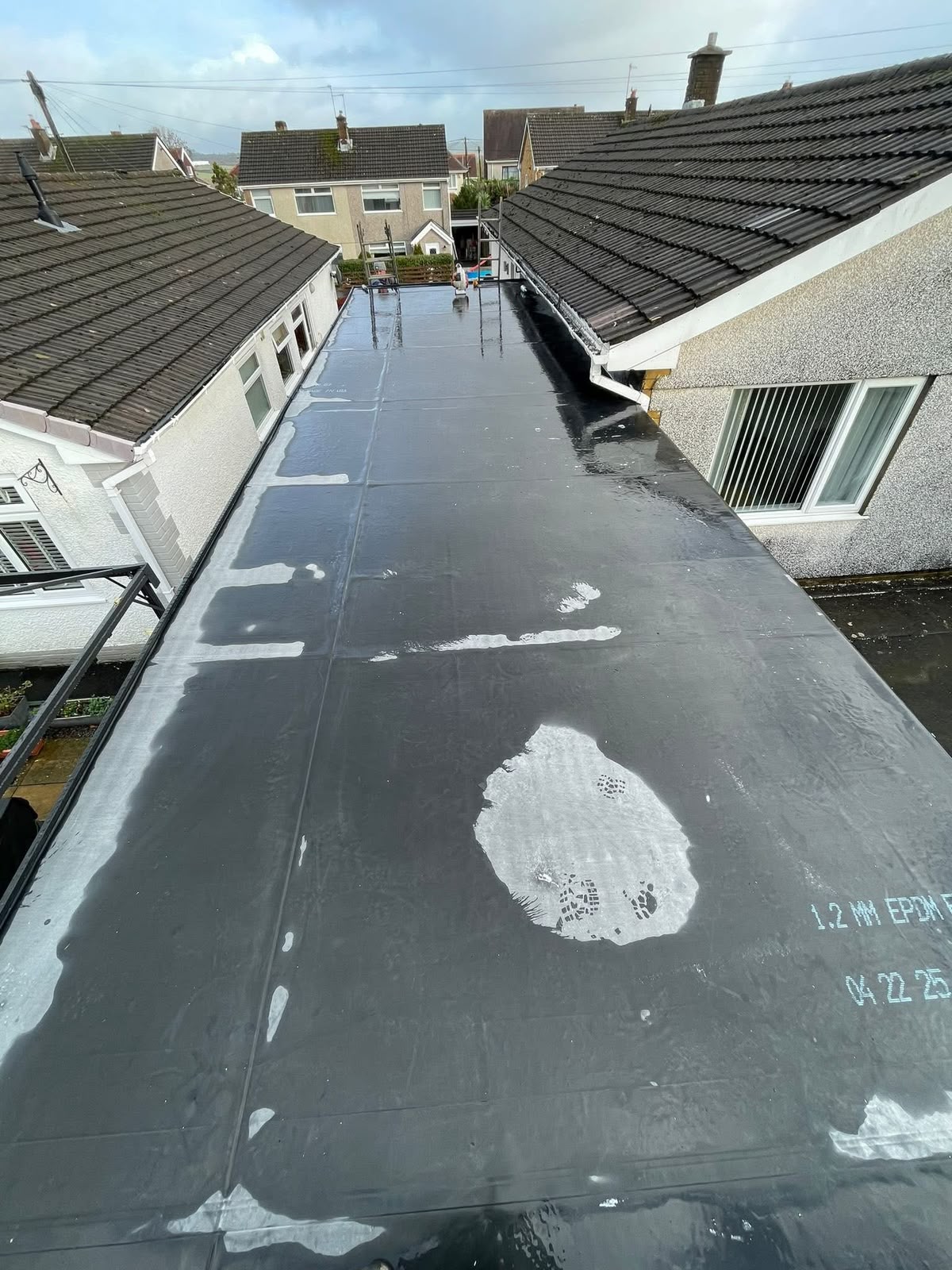
Flat roofing covers the low-pitch roofs over extensions, dormers, garages, porches and outbuildings. Modern systems are nothing like the felt they replaced: EPDM rubber is laid as a single sheet with no seams across the field, and GRP fibreglass cures into one continuous laminate.
We install both, and we repair existing felt, EPDM, GRP and asphalt roofs where the deck underneath is still sound.
Who it's for
Homeowners with a leaking or ponding felt roof over a kitchen extension or garage, anyone having an extension or dormer built who needs the roof done properly, and landlords with tired flat roofs on outbuildings.
Also anyone who has had the same flat roof patched repeatedly and wants it replaced with a system that doesn't have seams to fail.
Why professional work matters
Flat roofs don't fail in the middle. They fail at the edges: upstands, trims, outlets and the junction where the flat roof meets a wall. Those details are where the skill is, and where DIY kits and cheap installs come apart.
Falls matter too. A 'flat' roof isn't flat; it needs a designed fall so water leaves rather than sits. Correcting fall means work on the deck, which is why the survey has to happen before the price.
What happens if it's left
The cost of waiting
Old felt roofs fail on a predictable timetable. Bitumen felt goes brittle under UV, then cracks. Seams, the weak point of any felt roof, open first, usually where two sheets overlap or where the roof turns up against a wall. Water gets into the deck beneath, and because a flat roof deck is usually enclosed, it stays there.
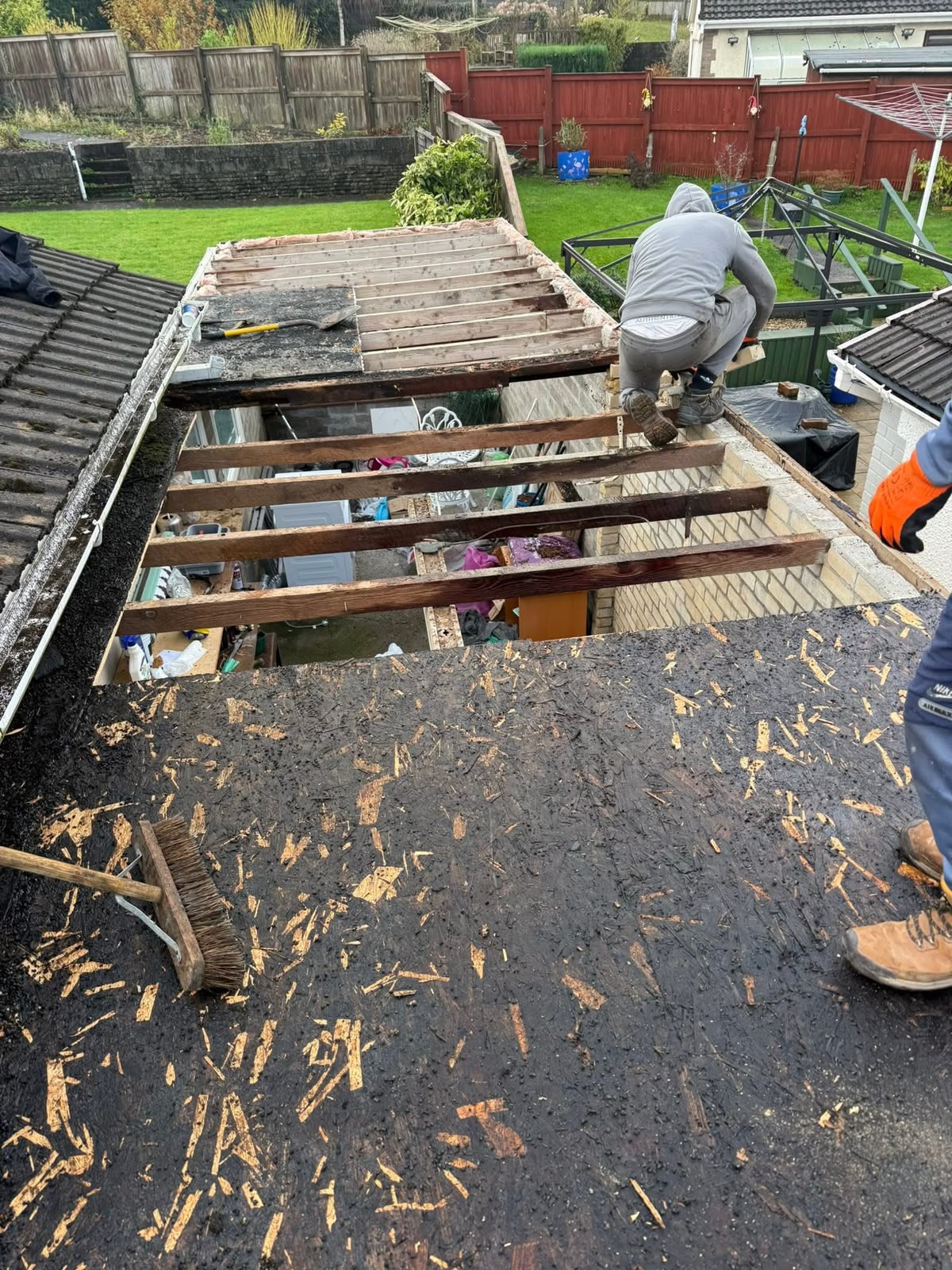
A wet flat roof deck is a slow disaster. Chipboard swells and delaminates. Timber joists rot from the top down. And because the ceiling underneath is often a habitable room, a kitchen, a bedroom in a dormer, the damage lands where it's most expensive.
Rotten deck and joists
Once the deck is saturated, replacing the covering alone isn't possible. The deck comes off and the joists get inspected, turning a covering job into a structural one.
Ponding that accelerates failure
Standing water magnifies UV damage, freezes and expands in winter, and loads the deck. Every day water sits there the roof ages faster.
Damage to the room below
Flat roofs sit over kitchens, extensions and dormer bedrooms. Water damage there means ruined ceilings, units, flooring and decoration.
Repeat patching that never holds
Patching a felt roof that has failed from UV degradation is patching one square metre of a covering that has aged uniformly. The next split is already forming somewhere else.
Common mistakes we're called in to undo
Layering new felt over old; it traps moisture and adds weight without fixing the deck
Using a DIY fibreglass kit and getting the catalyst ratio or the weather window wrong
Ignoring ponding water because 'it dries out eventually'
Terminating the roof against a wall without a proper upstand and flashing
Blocking or undersizing the outlet so the roof can't drain quickly enough
Our process
How we run a flat roof installation & repair job
STEP 01
Survey and deck check
We assess the existing covering, check the deck for softness and moisture, look at falls, upstands and outlets, and establish what actually needs to happen.
STEP 02
System choice and fixed price
We recommend EPDM or GRP based on the roof's size, shape, detailing and use, explain why, and give you one written fixed price for the full job.
STEP 03
Strip and prepare
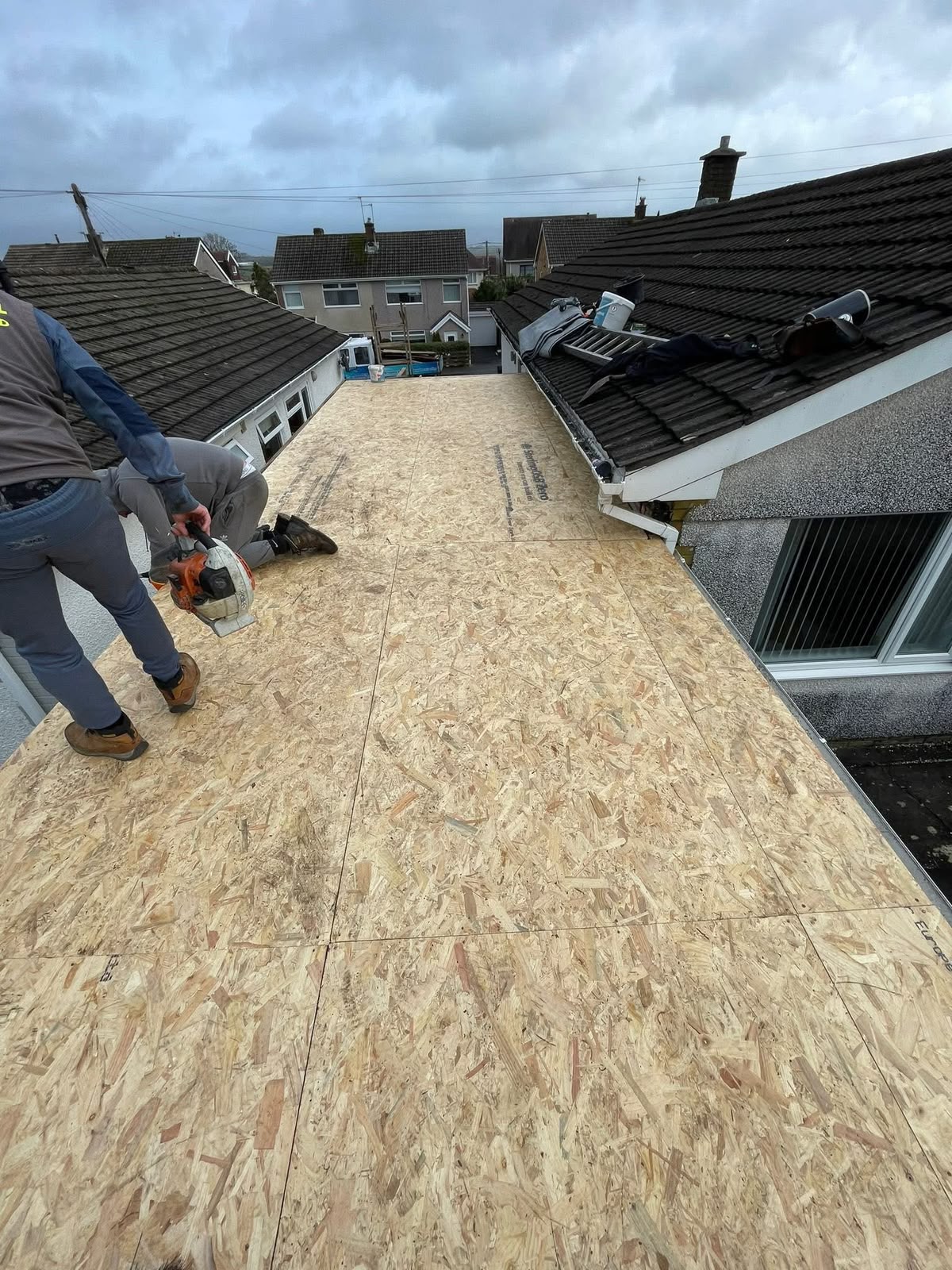
Old covering removed, deck repaired or replaced where wet, falls corrected, and the substrate prepared so the new system bonds properly.
STEP 04
Installation
EPDM bonded as a single sheet with no field seams, or GRP laid up as a seamless laminate. Upstands, trims, drips and outlets detailed as part of the system, not as an afterthought.
STEP 05
Water test, verification and clear-up
We check the roof drains to the outlet with no ponding, confirm all edge detailing is sound, and clear the site of all waste.
What you get
Why homeowners choose Monarch for this work
No seams to fail
EPDM is laid as one sheet and GRP cures as one laminate, removing the overlapping joints that make felt roofs leak.
Built to drain, not to pond
Falls and outlets are corrected at deck level so water leaves the roof instead of sitting on it.
Detailing that lasts
Upstands, trims and outlets are formed as part of the system, which is where cheap flat roofs come apart first.
Long service life, low maintenance
Modern EPDM and GRP need very little attention beyond keeping the outlet clear, no annual re-coating.
Protects the room underneath
Flat roofs usually cover kitchens, extensions and dormer bedrooms. Getting the roof right protects the most expensive part of the house to repair.
One fixed price including deck work
Deck repairs, materials, labour and waste are priced together so the figure doesn't move mid-job.
In detail
Flat Roof Installation & Repair: materials, methods and variations
EPDM rubber roofing
EPDM is a synthetic rubber membrane supplied in large single sheets, bonded to the prepared deck. On most domestic roofs the entire field is covered by one piece with no joints at all, which eliminates the failure mode that defines felt roofing.
It stays flexible in cold weather, tolerates the freeze-thaw cycling we get in the west of Scotland, and handles the deck movement that comes with timber. It is quick to install with no naked flame on the roof, and it's forgiving of awkward shapes.
Single-piece membrane, no field seams
Stays flexible through freeze-thaw cycles
No hot works or naked flame during installation
Well suited to garages, extensions and simple rectangular roofs
GRP fibreglass roofing
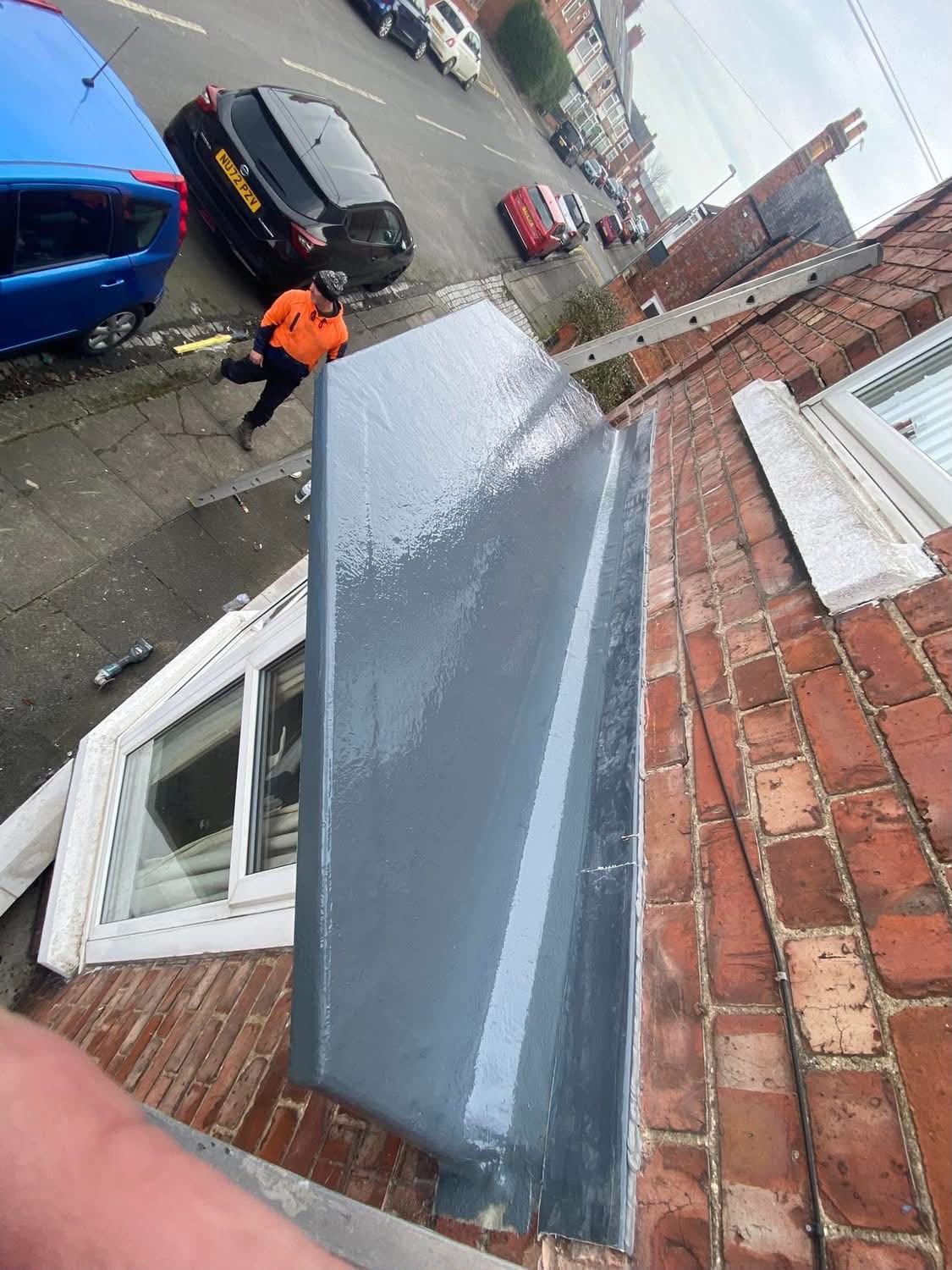
GRP is laid wet: chopped strand matting saturated with resin, cured in place into a rigid, seamless laminate, then finished with a coloured topcoat. It bonds to purpose-made trims to form continuous edges and upstands.
It gives a hard, walkable, very neat finish, which makes it the better choice for balconies, terraces and roofs that are seen from windows above. It needs dry conditions and correct temperatures to cure, so installation is weather-dependent, one reason DIY kits fail so often here.
Seamless, rigid laminate finished with a coloured topcoat
Walkable, suits balconies and terraces
Integrated GRP trims form continuous edges and upstands
Neat, uniform appearance when overlooked from above
Repairing an existing flat roof
Replacement isn't always necessary. Where a felt, EPDM, GRP or asphalt roof has a localised failure and the deck underneath is dry and sound, a targeted repair is far cheaper and can add years.
The deciding factor is the deck. If it's soft underfoot, if the ceiling below is stained across a wide area, or if the covering has degraded uniformly rather than failing at one point, repair is a short-term measure and we'll say so.
Where flat roofs are used
Flat roofing turns up in more places than people expect, and each has its own detailing requirements.
Kitchen and single-storey rear extensions
Dormer roofs and dormer cheeks
Detached and integral garages
Porches and bay-window tops
Balconies and walk-on terraces (GRP)
Outbuildings, workshops and garden rooms
Small commercial units and flat-roofed shop rears
Insulation, ventilation and build-up
A flat roof over a habitable room needs the right build-up as well as the right covering. Warm-deck construction puts insulation above the deck and beneath the membrane, keeping the structure warm and avoiding interstitial condensation. Cold-deck construction puts insulation between joists and requires ventilation above it.
Getting this wrong produces water on the underside of the deck that looks exactly like a leak but isn't. Where the roof covers a heated room, we'll discuss the build-up rather than just re-covering what's there.
Residential and commercial flat roofing
Domestic flat roofs are typically small, awkward and detail-heavy, lots of upstands and abutments relative to their area. Commercial flat roofs are usually larger, simpler in the field, and driven by drainage capacity and access for plant.
We work on both. On commercial jobs the priority is usually completing without disrupting the business below, which affects sequencing rather than specification.
Questions
Flat Roof Installation & Repair FAQs
It's driven by area, the amount of edge detailing, whether the deck needs replacing and which system you choose. We survey first, then give you one fixed price covering deck work, materials, labour and waste removal, no day rates.
EPDM is excellent on garages, extensions and simple shapes, and copes very well with cold and movement. GRP gives a harder, walkable, neater finish and is the better pick for balconies, terraces and roofs overlooked from above. We'll recommend based on your roof and explain why.
Most domestic flat roofs are completed within a few days. GRP needs dry weather and suitable temperatures to cure, so we plan around the forecast and tell you if weather moves the date.
Properly installed EPDM and GRP systems are long-life coverings that far outlast the built-up felt they replace, with very little maintenance beyond keeping the outlet clear.
Yes, if the deck is dry and sound and the failure is localised. If the deck is soft or the covering has degraded across the whole roof, we'll tell you that patching won't hold rather than take the easy money.
Because the fall is insufficient or the deck has deflected. Simply re-covering over the same profile keeps the ponding. We correct falls at deck level as part of the job.
Our 15-year workmanship guarantee applies to new roof replacements. Guarantee terms for flat roofing work are confirmed in writing with your fixed-price quote.
Yes. We offer 24/7 emergency roof repairs; we'll make it safe and stop the water, then return to complete a permanent repair or replacement.
GRP is walkable and suits balconies and terraces. EPDM tolerates occasional maintenance access but isn't intended as a walking surface. Tell us how the roof will be used and we'll spec accordingly.
Glasgow, Ayrshire, Greenock, East Kilbride, Hamilton, Lanarkshire, Bearsden, Milngavie and Cambuslang.